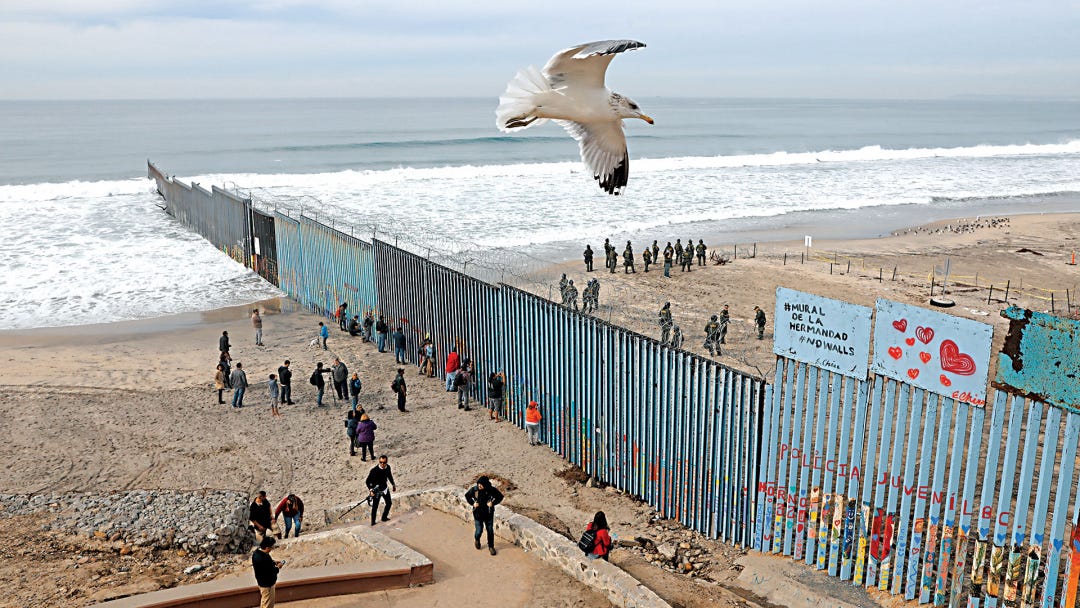
Artificial Boundaries

“Oh, the leaky boundaries of man-made states!
—Wislawa Szymboska
Good Morning Readers,
I’m reposting my post from December 27. I should have skipped Saturday
the 27th because of the Holidays.
The above line is the first line from Wislawa Szymborska’s poem
Psalm,” which is below. Much of the conflict in the world is because
humans, for a variety of reasons, create boundaries between things
that the rest of nature doesn’t recognize or honor. Here’s “Psalm.”
PSALM
Oh, the leaky boundaries of man-made states!
How many clouds float past them with impunity;
how much desert sand shifts from one land to another;
how many mountain pebbles tumble onto foreign soil
in provocative hops!

Need I mention every single bird that flies in the face of frontiers
or alights on the roadblock at the border?
A humble robin - still, its tail resides abroad
while its beak stays home. If that weren't enough, it won't stop bobbing!

Among innumerable insects, I'll single out only the ant
between the border guard's left and right boots
blithely ignoring the questions "Where from?" and "Where to?"

Oh, to register in detail, at a glance, the chaos
prevailing on every continent!
Isn't that a privet on the far bank
smuggling its hundred-thousandth leaf across the river?
And who but the octopus, with impudent long arms,
would disrupt the sacred bounds of territorial waters?

And how can we talk of order overall?
when the very placement of the stars
leaves us doubting just what shines for whom?
Not to speak of the fog's reprehensible drifting!
And dust blowing all over the steppes
as if they hadn't been partitioned!
And the voices coasting on obliging airwaves,
that conspiratorial squeaking, those indecipherable mutters!

Only what is human can truly be foreign.
The rest is mixed vegetation, subversive moles, and wind.
Translated by Stanisław Barańczak and Clare Cavanagh
Symborska uses a light, humorous and ironic tone in the poem, which
contrasts with the serious subject, making the absurdity of human
boundary-building even more pronounced. We are the intruders in the
natural world, not the other way around. Insects and animals ignore
our foolishness. She also titles the poem, “Psalm,” which is typically
an Old Testament song of praise for God’s creation. The psalm is for
the freedom of the natural world, not the restrictions of the human
world.
Szmborska has several poems that address the arbitrary, fleeting,
human-centric, and ultimate meaninglessness of political borders and
boundaries. None are better than this one. I live in a rural area in
Santa Fe County. The property lots are an acre or more. There’s plenty
of space between homes. I have a neighbor whose property is 25 acres
or so. The lot was unfenced when they bought it. Before they bought it
and built a home, I would walk my dog across it.
Soon after building their house, they put up a chain-link fence with
“No trespassing” signs every 30 feet or so around their property. The
number of signs in the wide open space seems absurd. It makes their
property look like a high-security facility. Coyotes walk past the
signs. Ravens fly over them. Clouds float over them. Maybe the sign
postings are comforting to the people who live there. I try to
understand what’s behind the signs. Fear? Probably.
It seems history teaches that humans cannot coexist without defined
borders, even between my house and yours, but as “Psalm” illuminates,
we really do need to understand just how much or how little they are
good for.
These are my questions for you this week: What do you do to break down
barriers? The opposite question: What barriers do you still hold? What
keeps you from letting go of them?
I look forward to hearing your comments.
David